Global Warming And Commercial Refrigeration
The Global Warming Solutions Act, or AB-32, was signed into law in September 2006 by Governor Schwarzenegger as the linch-pin of his strategy to provide the state with a comprehensive program of regulatory and market based mechanisms to reduce greenhouse gas emissions within the state of California. A broad base of California’s businesses were affected by the law on January 1, 2010 because of the impact the law has on specific commercial refrigeration gases that have been categorized as greenhouse gases.
 The Stationary Equipment Refrigerant Management Program covers all non-residential, fixed commercial refrigeration equipment and requires the reduction of refrigerant emissions from commercial refrigeration with high global warming potential. In other words, AB-32 limits the use of chlorofluorocarbons, hydrochlorofluorocarbons, perfluorocarbons and hydrofluorocarbons. While these substances were already regulated by the Environmental Protection Agency (EPA) through the US Clean Air Act, the Refrigerant Management Program as it relates to commercial refrigeration expands their control within the state of California.
Commercial Refrigeration Compliance
Beginning January 1st, 2011 all organizations within the state of California that have commercial refrigeration systems that use more than 50 pounds of high global warming refrigerant substances must be in compliance with the restrictions imposed by AB-32 and the Refrigerant Management Program. For most small businesses that have commercial refrigeration or cooling systems this won’t be an issue, but for larger organizations like supermarkets, grocery stores, food processors, warehouses and other cold storage facilities, and manufacturers that use industrial process commercial refrigeration they will most likely be affected.
All facilities (large and small) will be required on January 1st, 2011 to initiate a leak detection, monitoring, and record keeping program for their commercial refrigeration systems. This means a continuous monitoring system must be in place that alerts the organization of a leak. The leak detection system can be a direct system that detects the presence of leaky commercial refrigeration systems or an indirect system that interprets measurements like temperature or pressure within the commercial refrigeration system. Both options require that the owner of the system contacts a certified technician when needed to fix the leak as soon as it is detected. As of January 1, 2011 all technicians involved in servicing facility equipment must be US EPA certified and must follow required service practices when determining root cause and fixing the leak in the commercial refrigeration.
Commercial Refrigeration Cost Savings Potential
Overall, the opportunity for controlling the emission of greenhouse gases from commercial refrigeration systems can present a cost saving opportunity to organizations that use them. It has been estimated that facilities that reduce their leakage of commercial refrigerants from 30% per year down to 10% can save approximately $2,200 per 1000 pounds of refrigerant per year. Additionally, the impact to the environment from this program will be a drastic reduction in the contribution of greenhouse gases to the atmosphere by California organizations that utilize commercial refrigeration systems.
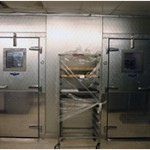 A walk-in commercial refrigeration unit is just what its name implies: a refrigerator big enough to walk into. It can be as small as a closet or as large as a good-size room, but its primary purpose is to provide refrigerated storage for large quantities of food in a central area. Experts recommend that your operation needs a commercial refrigeration walk-in when its cold storage needs exceed 80 cubic feet, or if you serve more than 250 meals per day. Once again, you’ll need to determine how much you need to store, what sizes of containers the commercial refrigeration storage space must accommodate, and the maximum quantity of goods you’ll want to have on hand at any time.
 For some food service operations you might also need more than one commercial refrigeration unit if you need to store perishable items at various temperatures. For instance, you’ll need one for produce (41 degrees Fahrenheit), one for meats and fish (33 to 38 degrees Fahrenheit), and one for dairy products (32 to 41 degrees Fahrenheit). If this is your situation, then determining the commercial refrigeration storage you need is a bit more complex, but nothing that can’t be determined with a little planning.
 Door hinges for your commercial refrigeration walk-in can be rubbed with petroleum jelly to make sure they continue to work well. If these develop a build-up of grease or grime, then their operation will not remain smooth. This means they will begin to stick resulting in your doors not closing automatically and the cold air escaping. Again this will result in lower efficiency for your commercial refrigeration walk-in and higher energy costs.
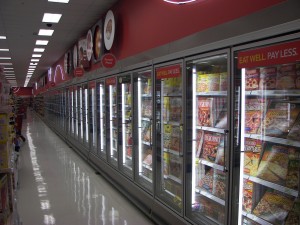 Counter top display units are great for getting customers to make impulse purchases. They are most effective when placed at checkouts and pay points. So when people are lining up to pay, they are enticed to make a last minute purchase by the food items on display in the commercial display refrigerator or freezer. This is a proven fact and is a method employed by all major food retailers. By placing a counter top display refrigerator or freezer in this location, you are improving the chances of a sale being made. By placing high impulse goods such as ice cream and other treats inside the display unit, you are even further increasing the likelihood of a sale being made.
 Whenever most of us think about refrigeration all we know about is the refrigerator we have in our home. We usually don’t consider the fact that the restaurants and grocery stores we patronize use commercial refrigeration to keep the food we buy from them preserved and fresh with commercial refrigeration. Commercial refrigeration differs from the cooling appliances we have in our homes mostly by size. There are other differences in commercial refrigeration such as the method by which the air is cooled. The choice for the restaurant owner or grocery store owner as to which type and size of commercial refrigeration they choose come down to the needs of their business.